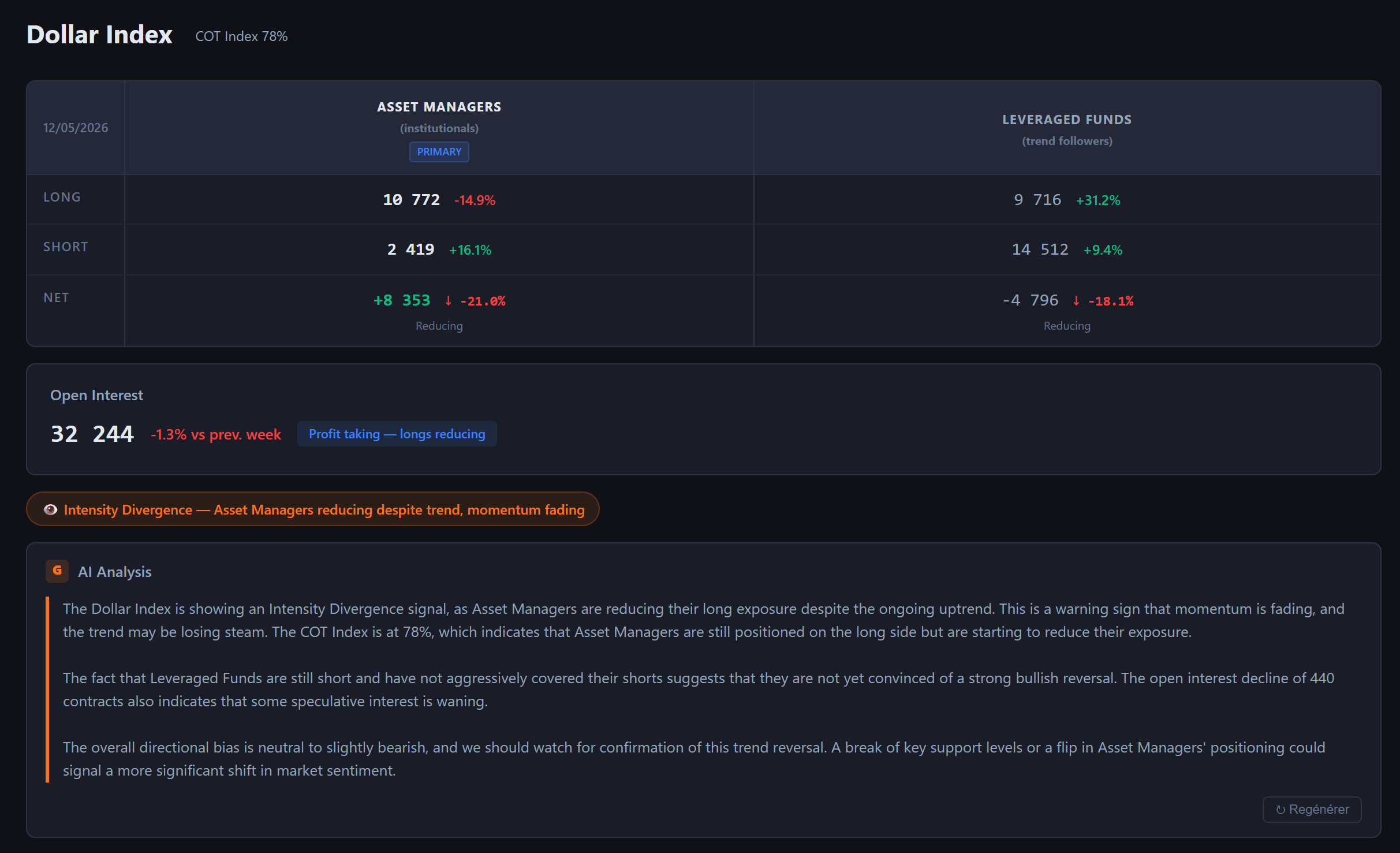
Raw CFTC data, turned readable — no CSV, no calculations.
Sorted by signal priority and amplitude — flips, extremes, and divergences surface automatically.
Same data. Processed automatically — no spreadsheet, no CSV.
Nine recurring positioning patterns. Surfaced on the right asset, the week they occur.
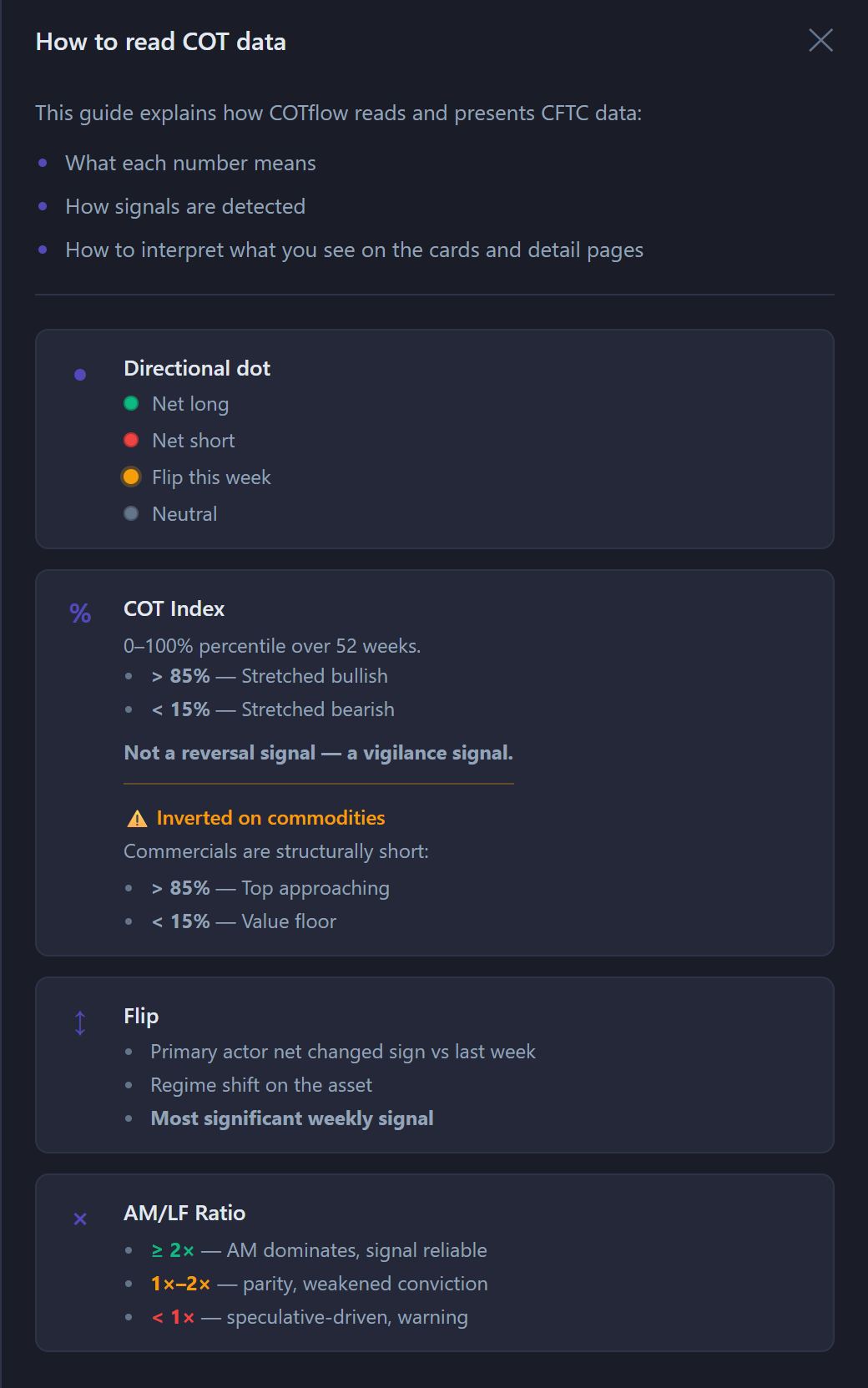
Position at a 52-week boundary — vigilance signal, not a reversal. The real warning is the first week of reduction.
Primary actor net changed sign — regime shift. Most significant weekly signal.
Primary actor reducing conviction for 2+ consecutive weeks. Flip precursor.
Both institutional actors on the same side simultaneously — rare and strong directional signal.
AM reducing despite established trend (intensity fade) or flipping short on DXY (global Risk On shift). Forex only.
Record short = top approaching. Massively covering shorts = value floor signal. Commodities only.
Real Money exiting while speculatives enter — bubble or violent reversal precursor. Indices only.
Institutionals out, only speculatives sustaining the market. High crash risk. Indices only.
AM flip long + OI surge on CME crypto — dominant bullish signal. Crypto only.
Everything is explained in context — what each number means, how signals are detected, and why it matters for the market you're watching.
Five minutes is enough. Open it once a week, get current, close it.
Two ways in. Same dashboard, different breadth.
Anything missing? get in touch.
The CFTC publishes weekly positioning data showing how Commercials (hedgers), Managed Money (speculators), Asset Managers, and Leveraged Funds are positioned in futures markets. The data is public — but raw, late on Friday, buried in CSV columns. COTflow does the parsing.
No. COTflow surfaces what large players are doing. It doesn't tell you when to buy or sell. You combine it with your own price analysis, risk management, and strategy.
Built and maintained by Travis, a discretionary trader who uses it every Friday. Last data update: —.
Yes — with 6 separate scripts, no multi-asset view, and no weekly delta. If you like assembling tools, TradingView works. If you want the read done, COTflow does it.
COTbase is built for analysts who need everything. COTflow covers the markets most discretionary traders actually follow — with a UX built for a 5-minute weekly read, not a deep dive.
Yes — the data is public and free. What you're paying for is the processing, the weekly delta, the automatic highlights, and the time you don't spend in a spreadsheet.
The CFTC releases new data every Friday at 15:30 EDT. The dashboard refreshes automatically afterwards — nothing to do on your side.
The COTflow Playbook explains every highlight, every label, and every market-specific reading rule. Designed for traders who can read a chart but haven't worked with COT data before.
Yes — one click, no retention prompts. Cancellation is immediate; access ends at the next billing cycle.
Hi, I'm Travis. I've been trading Forex and Indices for a few years, using COT data as part of my weekly analysis.
Every Friday evening, the same routine: download the CFTC CSV, figure out which report applies to which market, build the charts. An hour and a half, minimum.
I built COTflow because nothing on the market fit — COTbase is too dense, Tradingster shows raw data, TradingView scripts don't aggregate across markets. So I built what I actually needed.